Why some endings do not need a villain
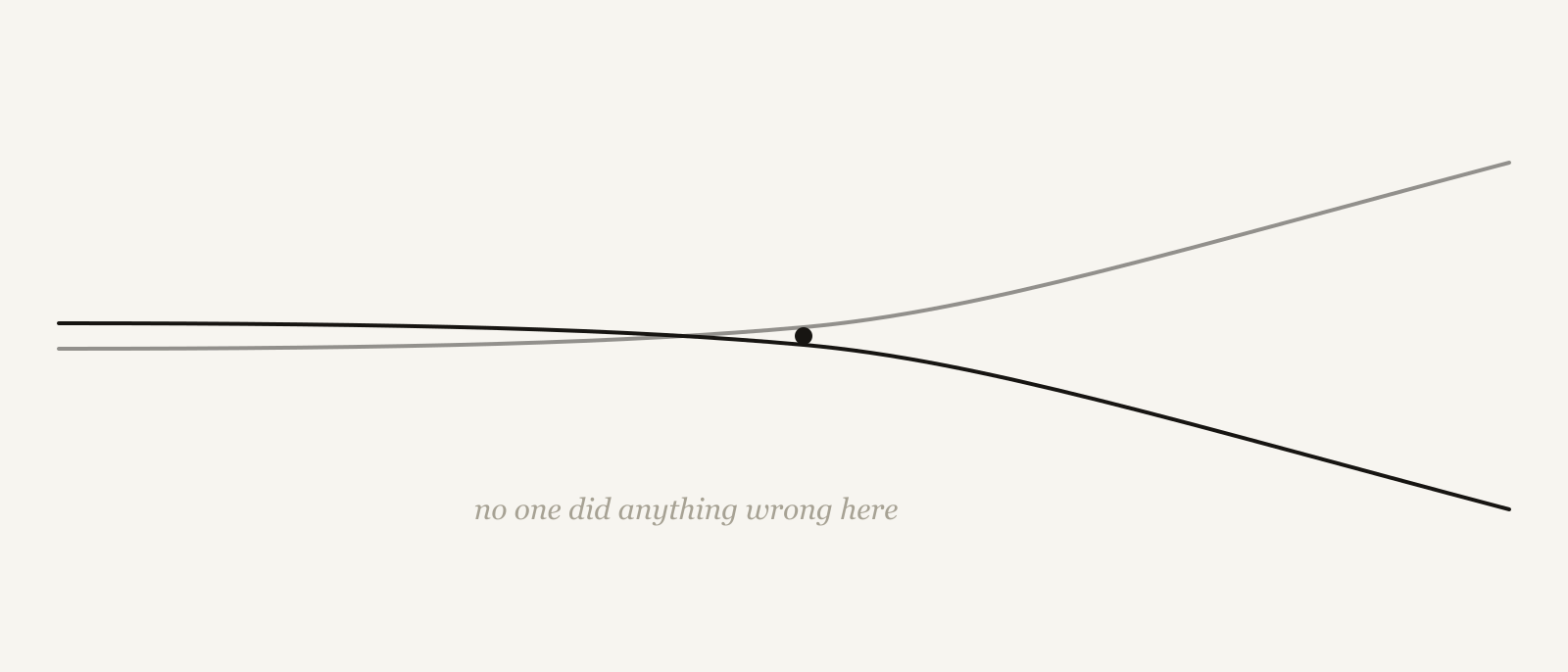
It is easier to leave a bad person than to leave a good person with whom life has stopped working.
I did not expect that to be true, and I resisted it for a while, because it sounds like the kind of thing people say to avoid a harder conversation. But I have watched it hold up too many times now, in relationships, in friendships, in jobs, in cities. Betrayal is painful and clarifying. Incompatibility is only painful.
What anger is for
When someone does something clearly wrong, the ending comes with an explanation attached. There is a reason, the reason has a name, and the name is a person. You get to be angry, and anger is load-bearing: it gives you energy, it gives you a story with a shape, and it gives everybody around you something to agree with.
Take that away and the whole structure has to stand on its own. Two people tried, both meant it, and it still did not work. There is nothing to prosecute. Nobody deserves what happened. You are left holding love and disappointment in the same hand, with no obvious place to set either of them down.
That is why people manufacture villains after the fact. I have done it. You go back through the archive looking for evidence, and you can always find some, because nobody survives that kind of audit. It is not dishonesty exactly. It is a search for a version of the story that parses.
The trouble is that the manufactured villain costs you the truth of the good parts. You cannot retroactively make someone the reason it ended without also making them not the person you actually loved. You end up protecting yourself from the ending by giving up the thing that made it worth having.
Two people who could no longer meet in the same place
Most endings I have seen up close were not caused by an event. They were caused by drift, and drift is nearly impossible to notice while it is happening.
Two people want different things, or want the same things on different timelines, or the version of life one of them can offer is not the version the other can live inside. Everybody is behaving reasonably. Everybody is doing their honest best with the information and the season of life they are in. And it still does not add up, because compatibility is not a measure of how much two people care. It is a measure of whether the lives they are each building can occupy the same space.
That distinction took me an embarrassingly long time to learn. Care is not the input that determines the outcome. You can put in an enormous amount of it and still arrive somewhere that does not work, and that arithmetic feels unjust because we are raised on stories where effort is the deciding variable.
What it costs to refuse the villain
Refusing to assign blame is more expensive than it sounds, because you give up the two comforts that blame provides.
You give up certainty. Without a villain, the question of whether it could have worked never fully closes, and you have to learn to leave it open without picking at it. And you give up a clean feeling about yourself, because if nobody was the problem then some of the responsibility is diffuse and quietly yours, and you have to sit with your own contribution without either inflating it into guilt or explaining it away.
What you get in exchange is that you are allowed to keep everything that was true. The good years stay good. The person stays a person. You do not have to edit your own history to make the ending legible, and you do not carry a grudge that you will have to keep feeding for years to keep alive.
I think that trade is worth it. I would not pretend it is the comfortable option.
Elsewhere
This is not only about relationships, which is why I think it is worth writing down.
People leave jobs where nobody wronged them and spend months hunting for the grievance that would justify the decision, when the truth was that the role and the person had grown in different directions. People leave cities they loved. People drift from friends who did nothing except become someone slightly different at a moment when they were becoming someone slightly different too. In every case the instinct is the same: find the fault, because a story with a fault in it is easier to tell at dinner.
Some things end because they are over. That is a complete explanation. It is simply not a satisfying one, and I have come to believe that the ability to accept an unsatisfying complete explanation is one of the more underrated adult skills.
You can hold what somebody meant to you and still say that it stopped working. Those two sentences do not cancel each other. Most of the honest endings I know are made of exactly that pair, held at the same time, by two people who both wish it had gone otherwise.
No account, no tracking. One vote per reader.