The arithmetic of proving it
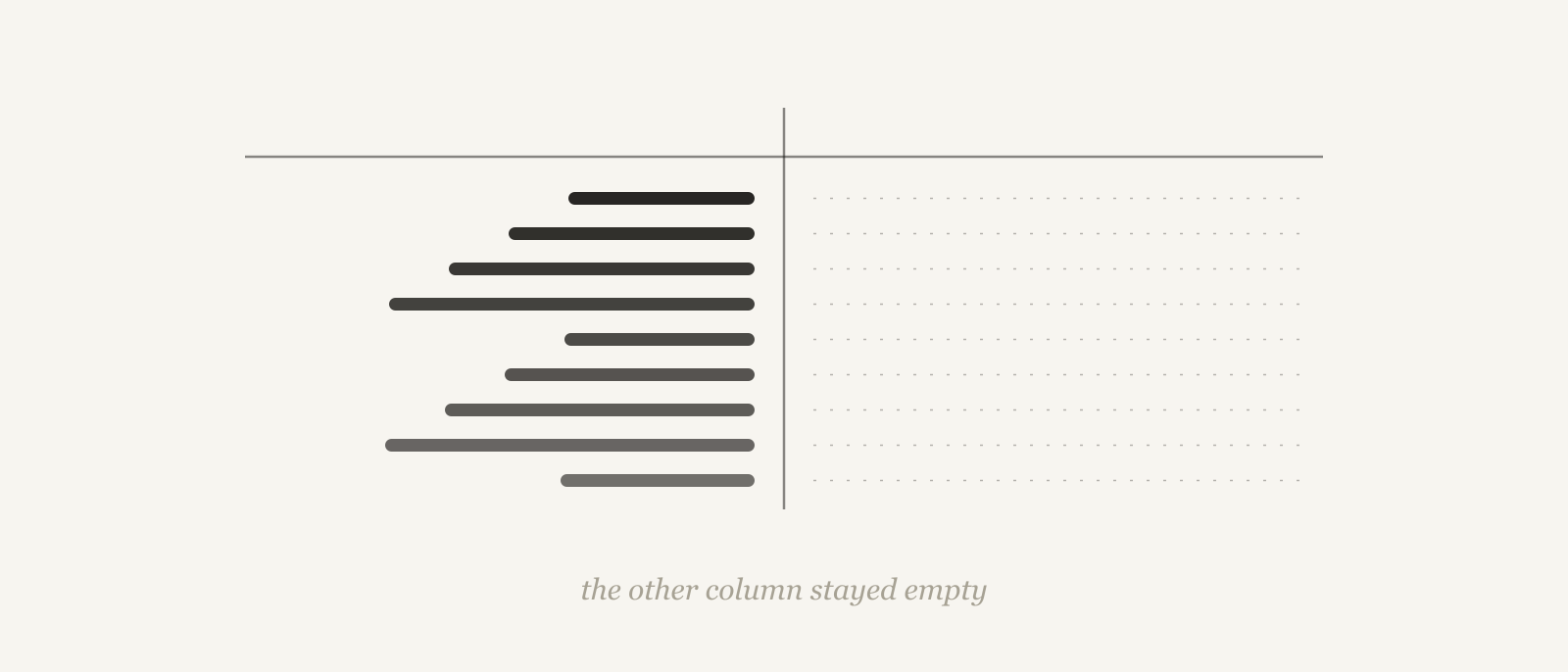
Money is the part everyone leaves out of stories about love. Time and effort are safe to mention. Put a number beside either one and you become the person who was counting.
I want to write about the counting.
Why it gets left out
There is an unwritten rule that money has no place in a story about love, and that mentioning it disqualifies you. Bring up what you spent and you stop being the person who gave generously and become the person who was counting, and everyone knows which of those two is the smaller man.
So the money gets edited out. People write about the calls, the waiting, the silences. They do not write about the arithmetic they were doing on the way home.
I understand the convention. I also think it protects the wrong thing, because money is the most auditable measure of devotion any of us actually has. Feelings are impossible to verify and easy to overstate. Effort can be claimed. Money has a number attached, and the number does not care how you felt while spending it.
Nobody spends from surplus at this age
The convention also assumes a kind of person who is not most of us. Generosity is only weightless if it comes out of surplus, and almost nobody in their early twenties has surplus.
What you have is a finite amount that has to cover everything, and every naira has a second identity as something else you were going to do. Money at this stage is not wealth, it is optionality: the runway that lets you take a risk, move, retrain, wait for a better offer instead of accepting a worse one. Spending it is not spending from a pile. It is spending your own future room to manoeuvre.
And in a country where prices move and everyone is quietly running conversions in their head all day, none of this stays abstract. The arithmetic is loud here. You always know what something cost in terms of the thing you did not do.
The difference between a gift and a submission
Here is the distinction it took me far too long to draw.
The same money, spent two ways, is two entirely different transactions.
One is a gift. You have it, you want them to have it, you give it, it is over. Nothing is expected back, nothing is being established, and afterwards you do not think about it again.
The other is evidence. You are spending to demonstrate something: that you are serious, that you are capable, that you can be relied on, that choosing you would not be a mistake. It looks identical from the outside. Same gesture, same amount, possibly the same smile. But it is a submission in an argument you keep having, and its purpose is to move a verdict.
That second kind never closes. A gift ends when it is given. Evidence is only ever filed, and the case stays open, and next month it needs restating.
The humiliation is not the amount
This is the thing I would want a younger version of me to understand.
What is degrading is not spending money on someone you love. That is one of the better uses of money there is. What is degrading is spending it in order to be chosen, because that transaction has already conceded the point. You cannot argue your way to being wanted, and every attempt to buy the argument confirms the premise that you have not yet earned what should not have needed earning.
You can be generous and proud at the same time. You cannot be a supplicant and proud at the same time. And the worst part is that it is not visible from outside, so nobody can tell you to stop. The gesture looks like affection. Only you know it was an instalment.
You are not allowed to say any of it
The trap closes because you cannot talk about it.
Raising it converts you instantly from generous into score-keeping, and it retroactively poisons everything you already gave. So the ledger stays private. You keep it in your head, you tell yourself you are not keeping it, and you keep it anyway.
Private ledgers do not stay neutral. They accrue. And because it is never discussed, the other person is answering a case they have not been shown, which is its own unfairness: they cannot possibly credit a debt nobody told them about. The resentment builds on one side of a conversation that never happened.
Somewhere in there I was doing something worse than spending money. I was buying reassurance and calling it love. Reassurance is not an asset. You do not own it afterwards. It has a shelf life measured in days, and when it expires the only move the system offers you is to buy more.
The moment the numbers show up
The turn came when I noticed I was calculating.
Not resenting, not refusing, just running the maths: what this costs, what it buys, whether it will be enough this time, what I will have left if it is not. Ordinary financial reasoning, applied to affection.
That was the answer, and I did not want to read it. When a relationship requires accounting, the accounting is not a symptom of your character. It is a measurement of the relationship, and it is telling you the returns are being calculated because they had stopped being obvious.
Love does not need a spreadsheet. If you are keeping one, you already know something you have not admitted.
What I would say now
I do not regret the money. Some of it bought real things: days that were genuinely good, and help given at moments when help mattered, and I would spend that again without thinking about it.
What I regret is the accounting. That it became accounting at all. That a stretch of my early twenties, the exact years when that money was also my freedom, went into arguing a case rather than building anything, mine or ours.
The rule I hold now is small and I think correct. Give freely, from what you actually have, to people who have already chosen you. The moment a gift becomes a submission, the problem is no longer the price. It is that you are paying down a debt you were never owed, at an interest rate you set yourself.
No account, no tracking. One vote per reader.