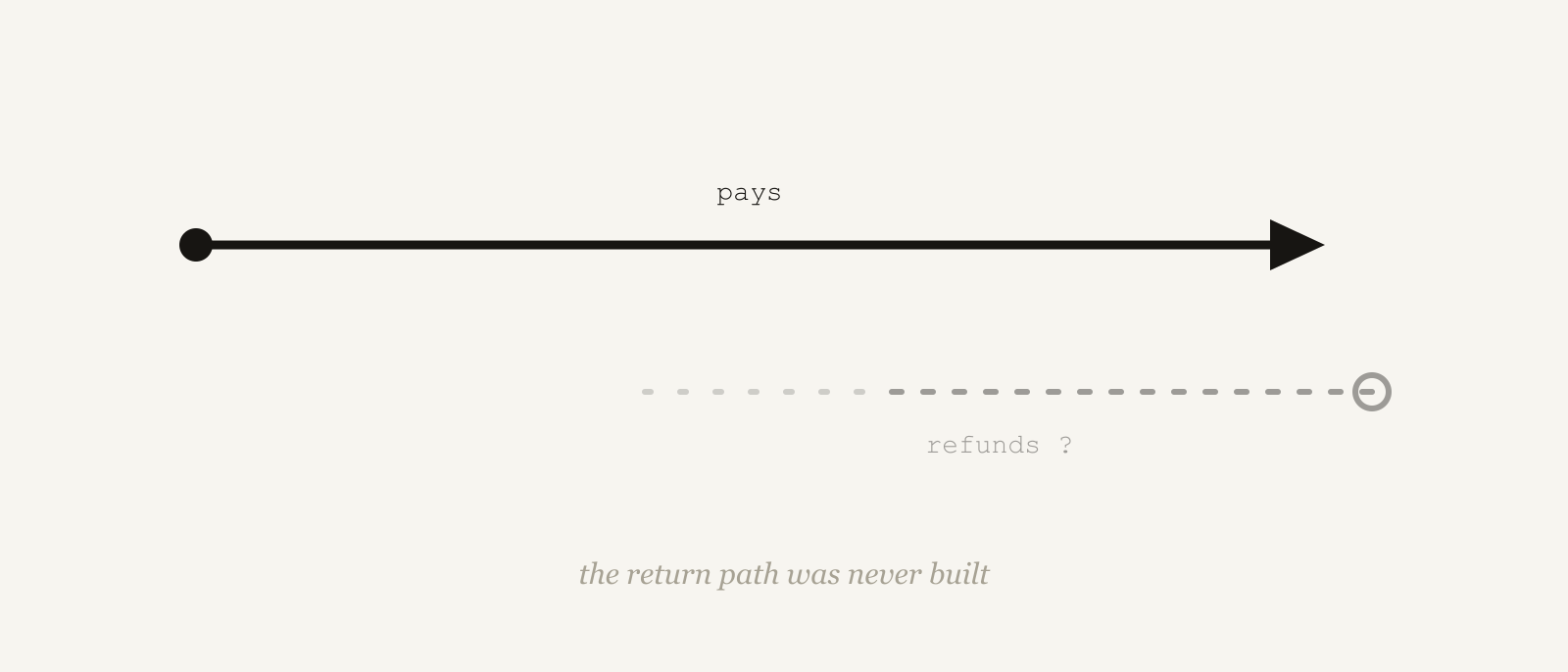
Agents can pay now. That was the easy half.
An agent can now pay for something without a human in the loop, and the mechanism is genuinely elegant. It requests a resource over plain HTTP. The server answers 402 Payment Required with a price, an asset and a destination. The agent signs a payment authorisation, a facilitator handles submission and gas and confirmation, and the agent retries the request carrying proof of payment. The server verifies and serves the thing.
I build consumer payments for a living. My reaction on reading the x402 specification was not scepticism, because the design is clean and the HTTP-native framing is right. My reaction was that it has solved the part of payments that was never the hard part.
First, honestly, how real is this
The number everyone quotes is that x402 on Base passed a hundred million cumulative transactions by the first quarter of 2026, up from near zero in mid-2025. Stripe added x402 support on 10 February 2026, USDC on Base, currently a preview rollout.
Both true, and both worth reading carefully before concluding the agent economy has arrived.
Chainalysis is candid that a large share of that growth was not autonomous commerce at all. Volumes surged in late 2025 “driven in large part by meme coin activity, particularly PING,” a pay-to-mint experiment that alone did over 150,000 transactions in its first month and briefly spiked weekly transactions by more than ten thousand per cent. Growth moderated in Q1 2026 as the speculation cooled, and their own conclusion is that whether this reflects sustainable adoption “or simply a different cohort of users remains to be seen.”
There is one genuinely encouraging signal buried in there: payments over a dollar went from 49 per cent of volume to 95 per cent by early 2026. The dust is thinning out and the remaining transactions look more like someone actually buying something.
So the honest position is that the rails are real and shipping, the headline number is inflated by speculation, and the interesting question is what happens as the amounts get larger. Which is where the rest of this matters, because moving money is maybe a tenth of a payment system. The other nine tenths is what happens when the first attempt does not go cleanly, and an autonomous agent is close to a worst-case client for that.
Idempotency exists, and it is an extension
I nearly wrote that agent payments have no idempotency story. That would have been wrong.
There is a Payment-Identifier extension. The client generates a unique payment id, the server caches the response against it, and a retry carrying the same id returns the cached result instead of charging again. Better still, servers bind that id to a fingerprint of the request covering scheme, network, asset, amount and path, so the same id arriving with different details gets a 409 Conflict rather than a cached response. That binding is well designed: it closes the hole where a client reuses an id for a different purchase.
The problem is the word “extension.”
Servers advertise support and may declare it optional or required. Clients may omit payment ids entirely where the server has not advertised it. The default path, the one you get by writing the obvious code against the obvious quickstart, does not have it.
In every payment system I have worked on, idempotency is not something you opt into. It is the ground floor, built before the charge call, because without it the retry that any real network eventually forces on you becomes a second debit. Making it optional means the specification’s happy path and its safe path are different paths, and people ship the happy one.
The documented fallback is to charge again
Under production considerations, the extension’s guidance includes this: “Handle cache failures gracefully - if cache is unavailable, process payment normally.”
Read that as a payments engineer. The component whose entire job is preventing a double charge, when it fails, is advised to step aside and let the payment through again.
That is fail-open on a safety control, and in money code the rule runs the other way. When the idempotency store is unavailable you refuse the request. Declining a payment is a bad afternoon; charging someone twice is a refund, a support ticket, and a customer who no longer believes you. You take the outage every time.
I understand why the guidance says it. Availability feels like the kind choice, and for a fifty-cent API call the arithmetic looks harmless. But it decides that the failure mode is duplication rather than denial, and that decision does not automatically get revisited when the same code ends up in front of something that is not fifty cents.
Two more details from the same page matter more for agents than for browsers. Caches carry a TTL, with the guidance suggesting five to fifteen minutes for time-sensitive resources and one to twenty-four hours for static ones, after which the same logical request is a fresh charge. And the advice to “persist payment IDs for long-running operations so they survive restarts” quietly concedes that by default they do not.
Now consider what is holding the wallet. An agent is an autonomous retry loop, running in a process that gets killed and restarted by a supervisor, an orchestrator, or an out-of-memory event, with no memory of what it paid for two minutes ago unless someone wrote that to disk. Process death mid-flow is not an edge case for agents. A protection that evaporates on restart is absent exactly when the client is most likely to retry.
The refund is the seller choosing to send it back
Here I have to correct myself again, because my first assumption was that refunds went unmentioned. They do not. The FAQ addresses them directly, and the answer is more interesting than silence.
For the standard exact scheme, the documentation describes it as a push payment, “irreversible once executed,” and the remedy it offers is business-logic refunds: the seller sends a new token transfer back to the buyer.
That is an accurate description of what is possible, and it is not a dispute mechanism. It is a request. There is no arbiter, no obligation, no timer, and no consequence for declining. If the seller takes the money and does not deliver, or delivers something broken, the protocol’s answer is that a refund may occur if the seller decides to send one. Every consumer protection anyone has ever relied on is the part where that decision is taken out of the seller’s hands.
This is not an oversight. It follows from the architecture. Settlement is on-chain and immediate, sold as instant, final and auditable, and finality is the same property as irreversibility. You cannot have settlement that is instant and final and also clawed back later, unless something holds the funds in between. Which is exactly what the card networks built, and exactly what this design was reacting against.
The exception is the most interesting thing in the specification. The batch settlement scheme has the buyer deposit into on-chain escrow once and then sign off-chain cumulative vouchers per request, redeemed by the seller in batches. Because the funds rest in escrow rather than moving on every call, that design has room for mechanisms the simple flow cannot have: a withdrawDelay after which a payer can unilaterally reclaim funds the seller has not claimed, plus cooperative refunds for idle channels.
That is a dispute window in embryo, and it exists for a reason worth naming. The moment you stop settling instantly and let value rest somewhere in between, reversal becomes possible again. It is the same trade the card networks made, arrived at independently, which should tell us something.
For a machine paying a machine a fraction of a cent for a data lookup, none of this matters much. Write off the loss. But the dollar-plus share of transactions went from half to nearly all in six months, and the direction of travel is larger amounts and more autonomy. The traditional machinery is not decoration; it is the accumulated scar tissue of every way this has already gone wrong, and skipping it does not make those failures stop existing.
What I would want before letting one loose
If I were putting an agent in front of a wallet with real money, the list is short and unglamorous.
Idempotency mandatory rather than advertised, failing closed rather than open, with the payment id written to durable storage before the request goes out rather than generated in memory alongside it. That last detail is the one people get wrong: an id that lives only in the process about to die is not a record of anything.
A way to ask afterwards. The most valuable endpoint in any payment system is the one answering “what actually happened to payment X,” because a timeout is not a failure, it is an unknown outcome, and the only correct response to an unknown outcome is to look rather than to try again. On-chain settlement gives an agent a real advantage traditional rails do not, since the ledger is public and it can genuinely verify rather than guess. I have not seen that reflex built into agent frameworks. They retry.
Spend limits enforced where the agent cannot reason around them. Not a number in a prompt. A ceiling in the signing layer, per hour and per counterparty, because the failure mode of an autonomous loop is volume and the entire premise is that nobody is watching.
And a receipt that survives, tied to what was ordered rather than only to what was paid, which is roughly what the signed offers and receipts extension is reaching toward.
Where this actually stands
x402 did the thing people had failed to do since the 402 status code was reserved and left empty for decades: it made paying for a request work, natively, over HTTP. That is a real achievement and the extensions arriving suggest the people building it know precisely which parts are missing.
But the celebration is running ahead of the substance in a specific way. A large slice of the headline volume was speculation rather than commerce. The duplicate-payment guard is optional and its own guidance says to charge again when it fails. The refund is a polite request to the counterparty. And the only mechanism resembling a dispute window exists in the one scheme where settlement is not instant.
None of that makes it a bad protocol. It makes it an early one, strongest in the half that was easier, which is the ordinary condition of new payment rails. It is worth being clear about which half that is, particularly before handing the wallet to something that never gets tired of trying again.
No account, no tracking. One vote per reader.